Reading Your Own Chat Statistics
Your own numbers are the only usage data you can actually verify, and they are easy to collect: sessions a week, minutes a session, messages a day. Ten messages a day is 300 a month; forty is 1,200; the arithmetic you write down yourself is worth more than any figure quoted about somebody else's audience.

Key takeaways
- Track four things: sessions per week, minutes per session, messages per day and saves per month.
- Message volume follows an assumption you can check — 10 a day is 300 a month, 40 a day is 1,200.
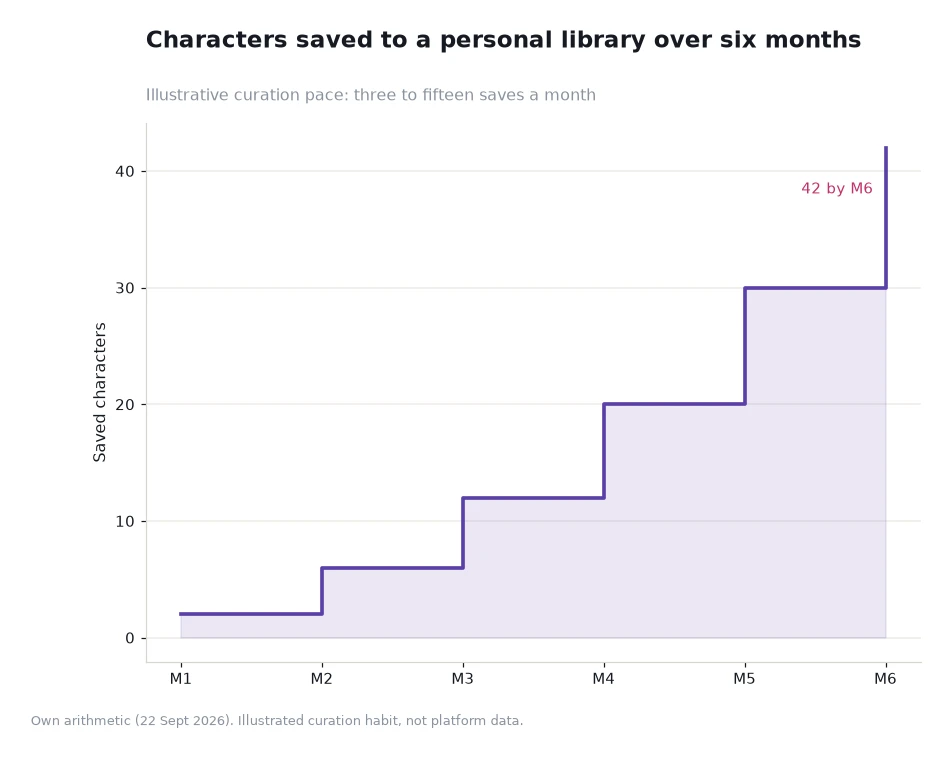
- Saves are the useful productivity number. Forty-two over six months is about seven a month.
- Compare your months against each other, never against someone else's totals.
Four numbers worth keeping
The first is sessions per week, because it describes the shape of the habit rather than its size. Four sessions a week is a routine; two sessions and one long weekend burst can produce the same monthly total and behaves nothing like it. Write the count down, not the impression.
The second and third are minutes per session and messages per day. Multiplying them gives you a monthly total you can compare month to month, and the multiplication exposes assumptions you might not have noticed: if you believed you were a light user and the log says forty messages a day on weekdays, the log is the more reliable source. The fourth number is saves per month, which measures output rather than consumption.
Two of the four numbers deserve a caveat. Sessions per week and minutes per session are easy to count but easy to mis-remember, so write them down on the day rather than reconstructing the month from memory. Messages per day is the softest figure of all, because a fair count means counting exchanges rather than messages, and the number moves depending on whether you count the turns you did not send. Use the same method every month and the trend will still be visible even if the absolute figure is approximate.
What each number tells you
Sessions per week tells you whether your habit is stable or bursty. A stable count is easier to plan around and easier to cut back if you decide to; a bursty pattern usually means the routine is not established yet, and adding more characters will make that worse rather than better.
Messages per day tells you what kind of writing you are doing. Low volume with long turns is a slow-burn reader; high volume with short turns is a conversational one. Neither is better, but the two produce very different experiences of the same catalogue, and knowing which you are explains a lot of otherwise puzzling dissatisfaction. Saves per month tells you whether your browsing is producing anything you keep.
| Metric | How to collect it | What it tells you |
|---|---|---|
| Sessions per week | Tick a note on the day you open a chat | Whether the routine is steady or bursty |
| Minutes per session | Rough start and end times for three sessions | Your real monthly hours, which set your patience for setup |
| Messages per day | Count exchanges in one typical session and multiply | Whether you are a long-turn or short-turn reader |
| Saves per month | Note additions to your list at month end | Whether browsing is producing anything you keep |
| Retirements per month | Note deletions at month end | Whether the library is being maintained or just enlarged |
Worked example
The chart below is the number most readers forget to track: saves accumulating over six months, at an illustrative pace of 2, 4, 6, 8, 10 and 12 additions a month, plotted cumulatively as 2, 6, 12, 20, 30 and 42.
Check the arithmetic line by line. Adding 2 gives 2. Adding 4 gives 6. Adding 6 gives 12; adding 8 gives 20; adding 10 gives 30; adding 12 gives 42. Divide 42 by six months and the pace is seven saves a month, which is a useful benchmark because it is small enough to maintain and large enough to be worth reviewing. Five of the six monthly additions fall inside the three-to-fifteen band the chart's subtitle describes, so this is not an enthusiastic month followed by silence — it is a flat, sustainable rate. If your own log shows a spike and four empty months, the honest conclusion is that the habit is not yet a habit.
Turning the numbers into decisions
Each metric suggests one action. If sessions per week are rising while saves stay flat, you are browsing more and keeping less — tighten the filters. If minutes per session are long but messages per day are low, your turns are heavy, and shortening them will give you more conversation for the same time. If retirements are zero for three months, the library has stopped being curated and the monthly review has quietly lapsed.
Use the platform's own tools to make measurement cheaper. A saved list is your saves counter, and the character cards give you the same two counters to read with character search when you want to compare your own keep rate against the catalogue's. Crushon's porn ai chat page describes adaptive replies and a private environment, and the FAQ entry answering what Porn Chat AI covers is a fair description of what to expect per session — none of which replaces your own log, but all of which helps you set a baseline for it.
Keep the log small enough to survive. Four numbers in a note file, updated weekly, is enough; anything more elaborate will be abandoned within a month. The AI chat blog is a reasonable place to read about how sessions are structured if you want a reference point for your own figures, and the aim of the exercise is simple: a habit you can see is a habit you can adjust.
A weekly review of the four numbers beats a monthly one, because a week is short enough to remember and long enough to show a change. Write the four figures in a line each Sunday, and read the last four lines together before making any decision. Three identical weeks followed by an outlier is noise; four weeks of the same drift is a trend, and trends are what you act on.
What to do with a bad month is the question that makes measurement worthwhile. A month with high session counts and no saves means the browsing is not converting; tighten the filters and shorten each session. A month with no sessions at all is not a statistics problem but a habit problem, and the useful response is to schedule one short session rather than to examine the numbers again.
Frequently asked questions
How long should I track before drawing conclusions?
A month is the minimum, and two months shows a pattern. Weekly samples bounce around enough that single weeks are misleading.
Is a high message count a good sign?
It depends on what you want. High volume with short turns suits quick exchanges; a lower count with longer turns suits slow stories.
Should I compare my numbers with other readers?
No, and the published counters are not a fair comparison either. Track your own months against each other, which is the only consistent baseline available.
Write down four numbers
Start a note with sessions per week, minutes per session, messages per day and saves per month, and update it once a week for a month. Then make one change based on what the numbers show rather than on how the habit felt. That is the whole method, and it costs about two minutes a week.
Notes: the message-volume and six-month library figures are illustrative arithmetic, while the platform references were read on 22 Sept 2026[1]. Source material for the references was read 22 Sept 2026. For a readership of adults, 18 and over.