A Closer Look at Supplier Discovery for Overseas Buyers
Supplier discovery is more effective when the buyer defines the needed capability before collecting names. A long list of vendors can still miss the required process, market evidence, or delivery capacity. Build a funnel from product scope and screening criteria to verified candidates, samples, and order-specific approval.
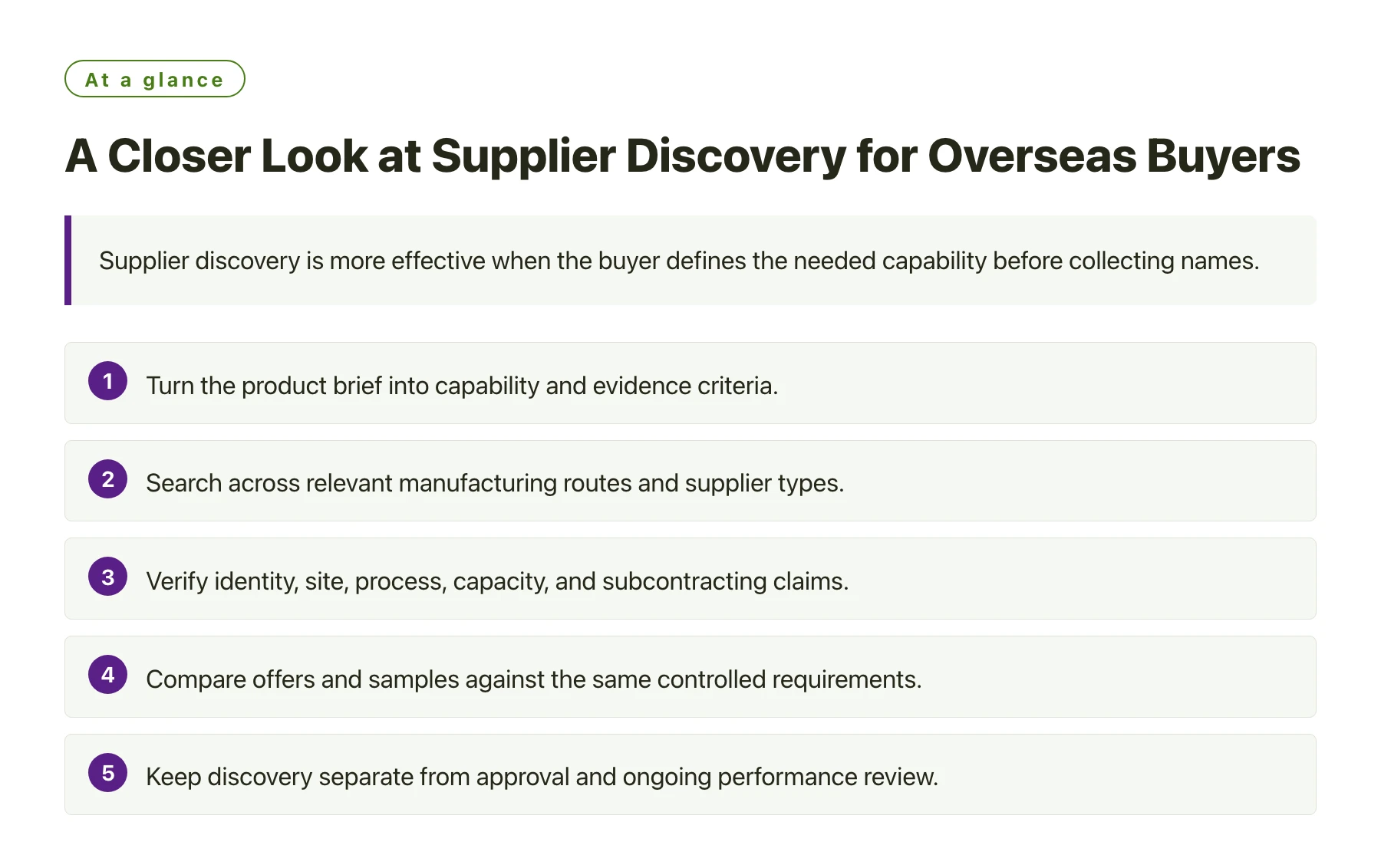
Key takeaways
- Turn the product brief into capability and evidence criteria.
- Search across relevant manufacturing routes and supplier types.
- Verify identity, site, process, capacity, and subcontracting claims.
- Compare offers and samples against the same controlled requirements.
- Keep discovery separate from approval and ongoing performance review.
A documented discovery funnel helps buyers compare relevant evidence and make a decision they can explain.
1. Translate the product brief into search criteria
Record function, materials, dimensions, process, certification or market evidence, customization, quantity, target price range, destination, and delivery window. Identify the features that distinguish a suitable manufacturer from a distributor or general trader.
Separate mandatory capabilities from preferences. Have engineering, quality, and compliance owners identify specialist requirements before outreach, especially for products with safety, electrical, medical, or structural risks.
2. Choose where and how to search
Use category knowledge, trade directories, referrals, exhibitions, industry associations, and existing supplier networks as lead sources. Confirm the source date and supplier identity; directory presence does not prove capability or active status.
Decide whether to contact factories directly, work through a sourcing partner, or compare both routes. Define who will screen candidates, verify factories, manage translation, and protect buyer data.
For a focused search, describe why each source is relevant and what it does not establish. Use different channels to find candidates, but apply the same evidence standard before comparison. Keep duplicates under control by recording legal name, trade name, site, contact, and relationship to the factory.
3. Screen for relevant manufacturing capability
Ask candidates to describe similar products, key processes, equipment, production volume, quality controls, material sources, subcontracted steps, and export markets. Request examples tied to the actual product rather than broad capability brochures.
Check whether answers are specific and supported. Ask which site performs each step and whether the quoted company controls production. Make a shortlist only after candidates meet the buyer’s minimum criteria.
4. Verify business and factory identity
Compare legal name, address, invoice party, site, certificate scope, and payment beneficiary. Verify critical information through appropriate registries, issuing organizations, references, or a site review. Document any trading company, parent, subcontractor, or alternate production location.
A website or certificate image is not enough for a high-risk claim. Record verification method, date, result, and limitations. Recheck details when ownership, address, or business relationship changes.
5. Request comparable evidence and offers
Send a controlled RFQ with specification, quantity, schedule, packaging, delivery location, standards, sample requirement, inspection, and documents. Ask candidates to identify exceptions, substitutes, and assumptions.
Use one comparison matrix for capability, evidence, quote, lead time, response quality, and open gaps. ISO 9001:2026 defines quality management system requirements; certification can inform a system review but does not replace product- or order-specific verification. [1]
Set a response deadline and ask for pricing validity, quantity tiers, and sample availability. Store clarifications with the offer version so later reviewers can see which requirements the supplier accepted and which remain conditional.
6. Reduce the shortlist through samples and review
Choose samples that represent the exact quoted configuration and state what will be evaluated. Record supplier, factory, model, revision, dimensions, functions, finish, labels, and documents. Set review criteria before examining candidates.
Use laboratory tests, site audits, or product specialists when the decision needs evidence beyond a visual sample. Mark missing evidence as pending instead of awarding a favorable score based on assumptions.
7. Assess risk and supplier concentration
Review single-source components, capacity, location, subcontractors, financial or schedule dependencies, export experience, and continuity plan in proportion to project risk. Consider whether a second source is practical and whether product interchangeability has been proven.
Document risk owners and mitigation triggers. A second supplier is not a true alternative until specifications, tooling, approvals, and sample conformity are sufficiently aligned.
Consider the cost of switching if a supplier is the only source for a critical component or tool. Record whether drawings, tooling, process data, or market documents can be transferred if continuity planning requires a second source.
8. Make a documented selection decision
Record why candidates advanced or were rejected, which evidence was reviewed, what gaps remain, and who approved the chosen source. Keep technical fit, compliance, commercial terms, and relationship preference as separate decision dimensions.
Do not promise an award until key checks are complete and contract terms are approved. Once selected, create a supplier file with current contacts, factory, product scope, documents, and performance review date.
9. Revisit discovery as needs change
New products, markets, quantities, regulations, and materials can change the supplier profile. Set a trigger to reopen discovery if capability, capacity, service, or risk no longer fits. Keep historical decisions so a new buyer can understand previous evidence.
Buyers using js-sourcing.com can define what discovery, verification, quote comparison, sampling, and follow-up support they need. Ask for the method and evidence behind recommendations and retain final supplier approval authority.
Sources
Frequently asked questions
How many suppliers should an overseas buyer shortlist?
Screen enough candidates to compare meaningful capability and risk, then advance only those meeting defined mandatory criteria.
Does a supplier directory verify manufacturing capability?
No. Treat directory listings as leads and verify legal identity, actual site, process, capacity, and evidence.
Should the lowest quote determine supplier selection?
No. Compare technical fit, evidence, capacity, delivery, total cost, and open risk before commercial preference.
When should supplier discovery be repeated?
Reopen it when product scope, market, volume, risk, capacity, or supplier performance changes materially.